
Every Road on Earth at the Speed of Light
I Bend Light for a Living. I Still Can't Picture It.
I'm an optometrist, which means I spend most of my day bending light.
That's not a metaphor. A pair of glasses is a carefully shaped piece of plastic whose entire job is to nudge light so it lands exactly on your retina, instead of slightly in front of it or slightly behind it. I explain refraction so often that patients occasionally get a glazed look. Professionally speaking, that's a tear film issue.
So you'd think I'd have a good feel for light. And I do, for where it goes. What I have no feel for at all is how fast it goes.
Light travels at 299,792 kilometres per second. I've known that number since high school. I have never once been able to picture it.
So I tried a different question: if light could drive, how long would it take to drive every road on Earth?
Why 299,792 km/s Means Nothing to You
Your brain was built for a world of thrown rocks, running deer and, more recently, merging onto Highway 2. It is very good at speeds it has personally experienced. It is useless beyond that.
The fastest thing most of us have ever ridden in is a passenger jet, cruising at roughly 900 km/h. Light goes about 1.2 million times faster than that. Compared with your car on the highway at 100 km/h, it's about 10.8 million times faster.
Those numbers don't help. A million times faster than a plane is not a thing a human can imagine. It just becomes "very fast," which is the same category your brain uses for a hockey puck.
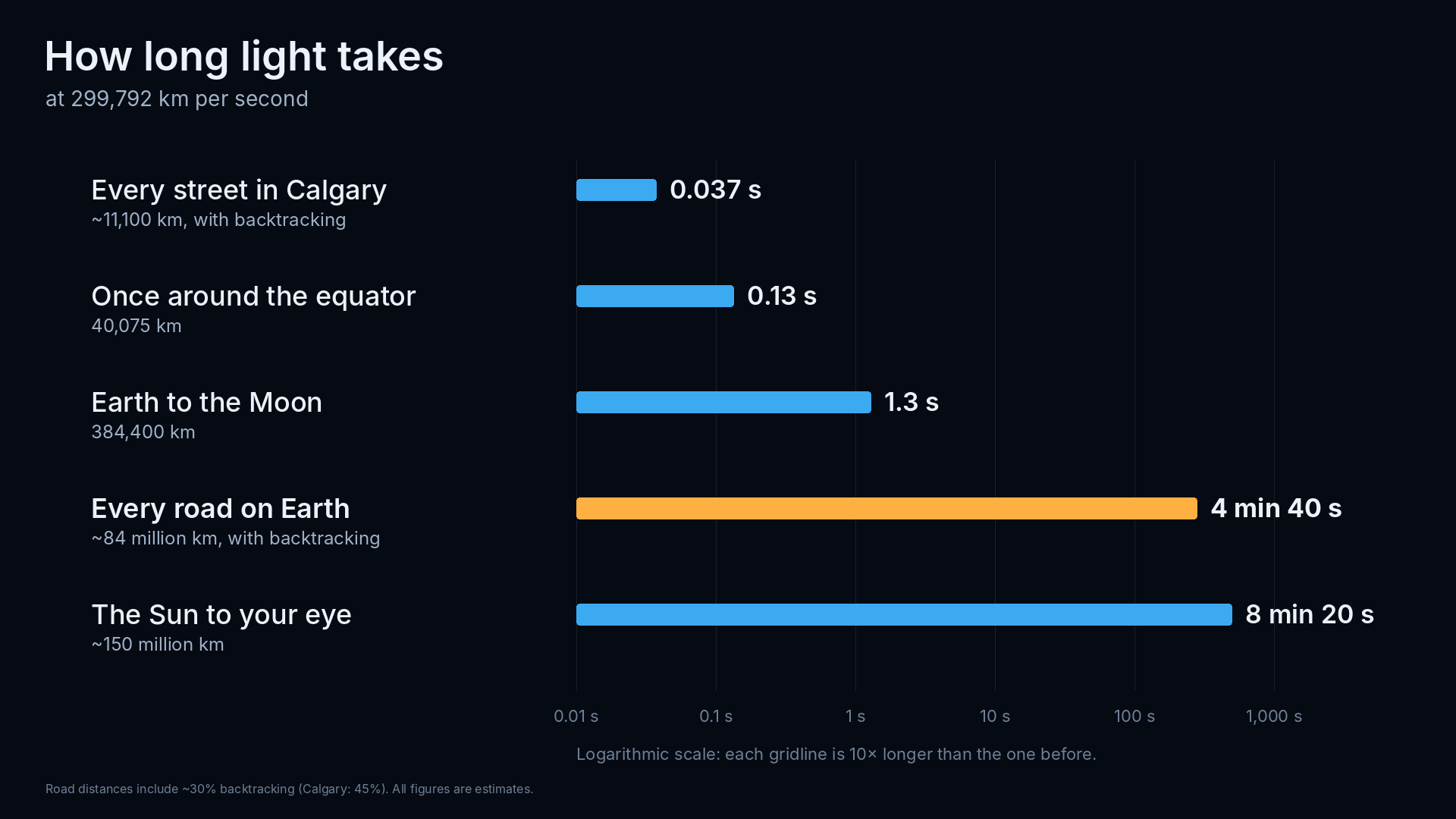
The usual fix is to compare light with space: it reaches us from the Sun in 8 minutes and 20 seconds. But that just swaps one unimaginable number (the speed) for another (150 million km). We're no closer.
So instead, let's use something everyone understands deeply and personally: roads. You've driven them, you've sat in traffic on them, and you know exactly how long it takes to get across town. Roads give our brains something to hold on to.
The Thought Experiment: Light Takes a Road Trip
The rules are simple. One tiny point of light. Every road on the planet. No skipping any.
How much road is there? The commonly cited estimate is about 64 million km. When I measured the drivable roads in OpenStreetMap (the giant volunteer-built map of the world), I got 64.2 million km. Close enough that I'm going to stop worrying about it.
You can't drive every road exactly once. Think about a dead end. You drive in, you have to drive back out, and now you've done that road twice. The same goes for cul-de-sacs, and for any intersection where an odd number of roads meet. Mathematicians have a name for this: the Chinese Postman Problem, after the mathematician Meigu Guan, who studied it in the early 1960s with a mail carrier in mind. What's the shortest route that walks every street at least once? The answer always involves some backtracking. A reasonable estimate for real road networks is about 30% extra.
Do the math. 64 million km of road, plus 30% backtracking, is about 84 million km. Divide by the speed of light:
84,000,000 km ÷ 299,792 km per second ≈ 280 seconds = 4 minutes 40 seconds
That's it. Light, driving like the world's most determined mail carrier, covers every road on Earth in 4 minutes and 40 seconds. That's about the length of a long song, and a bit more than half the time sunlight takes to get here.
North America: About a Minute
Numbers are nice, but I wanted to see it. So I built an animation using real road data. Roads not yet reached glow blue. Roads the light has driven turn gold and stay gold.
The trip starts at the top of Alaska. By 0:40 the light is in southern Ontario, and by about the one-minute mark most of Canada and the United States is gold. Add Mexico and Central America and North America takes roughly 80 seconds.
A few things jump out when you watch it:
The road map is basically a population map. The eastern United States fills in as a dense, glowing mat. The north is a few long, lonely threads.
Canada has sensibly put most of its roads within a few hundred kilometers of the US border. Then there are a handful of very committed highways heading north, spawning hundreds of snowplow businesses in it’s wake.
The light can't drive across water. When it needs to get to Hawaii or Newfoundland, it makes a hypothetical jump, marked with a little ring. Those jumps add no distance.
The Whole Planet: 4 Minutes 40 Seconds
Here's the full trip, in real time. If you watch all 4:40 of it, you have watched light drive every road on Earth at the actual speed of light. That's the part I find hard to get over.
The light spends the most time in Asia, because that's where most of the world's road is. Australia gets about ten seconds near the end. New Zealand gets the final second.
One thing the animation makes obvious: the light is not a straight beam. It zigzags, loops, backs out of dead ends and doubles back to pick up roads it missed. It's driving like someone who refuses to use a GPS but has an extremely good memory.
Calgary: Faster Than You Can Blink
Then I tried home. Calgary is city of about 1.5 million people and has about 7,664 km of public streets inside city limits. Add the backtracking, and there's a lot of it here, thanks to every Close, Bay and Crescent in the suburbs. Light covers the whole city in about 37 milliseconds.
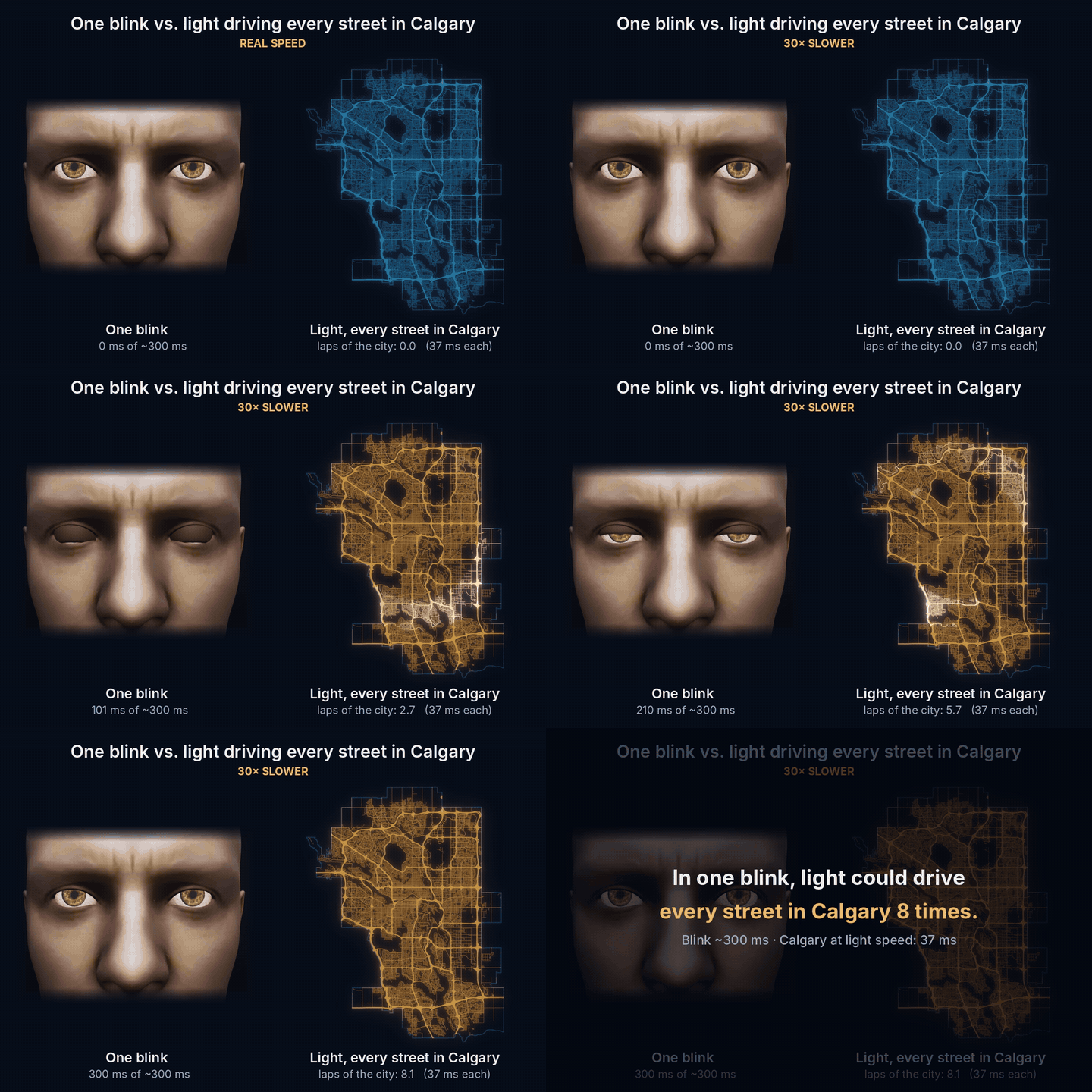
A blink takes somewhere between 100 and 400 milliseconds. So in the time it takes your eyelid to close and open once, light could drive every street in Calgary three to ten times over. You'd miss the entire thing. Your eye would still be halfway through its blink.
What This Has to Do With Your Eyes
Here's where the optometrist gets to justify this whole blog post.
Refraction, the thing I talk about all day, is light changing speed. Light only goes 299,792 km/s in a vacuum. When it enters something denser, it slows down. Your cornea slows it to about 218,000 km/s. The densest part of the lens inside your eye slows it to roughly 213,000 km/s.
If light hits that new material at an angle, one side of the beam slows down before the other, so the beam pivots. Picture pushing a shopping cart off the parking lot and onto grass at an angle: the wheel that hits the grass first drags, and the whole cart turns. That turn is focusing. Your cornea and lens are, essentially, carefully curved speed bumps for light.
Which means every prescription I write is really a plan for slowing light down by exactly the right amount, in exactly the right places, so it all arrives at your retina in focus. When I put it that way, my job sounds much cooler than "which is clearer, one or two?"
Now for the humbling part. Light crosses your entire eyeball, about 24 mm, in roughly 0.1 nanoseconds, a ten-billionth of a second, even after slowing down. When you read the eye chart across my exam room, the light from those letters reaches you in about 20 billionths of a second.
Your brain is the slow part. Even at its very fastest, it needs something like 13 milliseconds to recognize an image, and usually much longer to consciously "see" it. In those 13 milliseconds, light could drive about a third of Calgary's streets.
That's why the speed of light is so hard to picture: your eyes never need to notice it. As far as your visual system is concerned, light is instant. Every delay in seeing happens after the light arrives, in the retina and the brain, never on the way in.
So next time you're squinting at the bottom line of the chart, know that the light did its part in 20 nanoseconds. The rest is up to you. And me.
The Fine Print
This is a thought experiment, so a few honest caveats:
Light doesn't follow roads. It travels in straight lines and would leave the highway at the first bend. Also, nothing with mass can travel at light speed, so this is not a future commuting option.
The road data is real. It's © OpenStreetMap contributors, via Overture Maps. The world animation routes the roughly 17.7 million km of major roads (highways down to local connector roads). Smaller residential streets light up as the route passes near them. The Calgary animation routes every public street.
The 4:40 is an estimate. The 64 million km and the 30% backtracking are both approximations. On the actual map data, my route needed 39% extra on the world's major roads, and 45% on Calgary's cul-de-sac-heavy streets. Change what counts as a "road" (do you include gravel tracks? parking lots?) and the answer moves by tens of seconds. Somewhere between about 4:38 and 4:57 is fair.
Ocean crossings are free. Jumps between continents and islands are instant and add no distance.
The route is good, not perfect. It's computed over the real road network, but it isn't a proven optimal solution to the Chinese Postman Problem. Solving that exactly for the entire planet is a job for a much bigger computer and a much more patient optometrist.