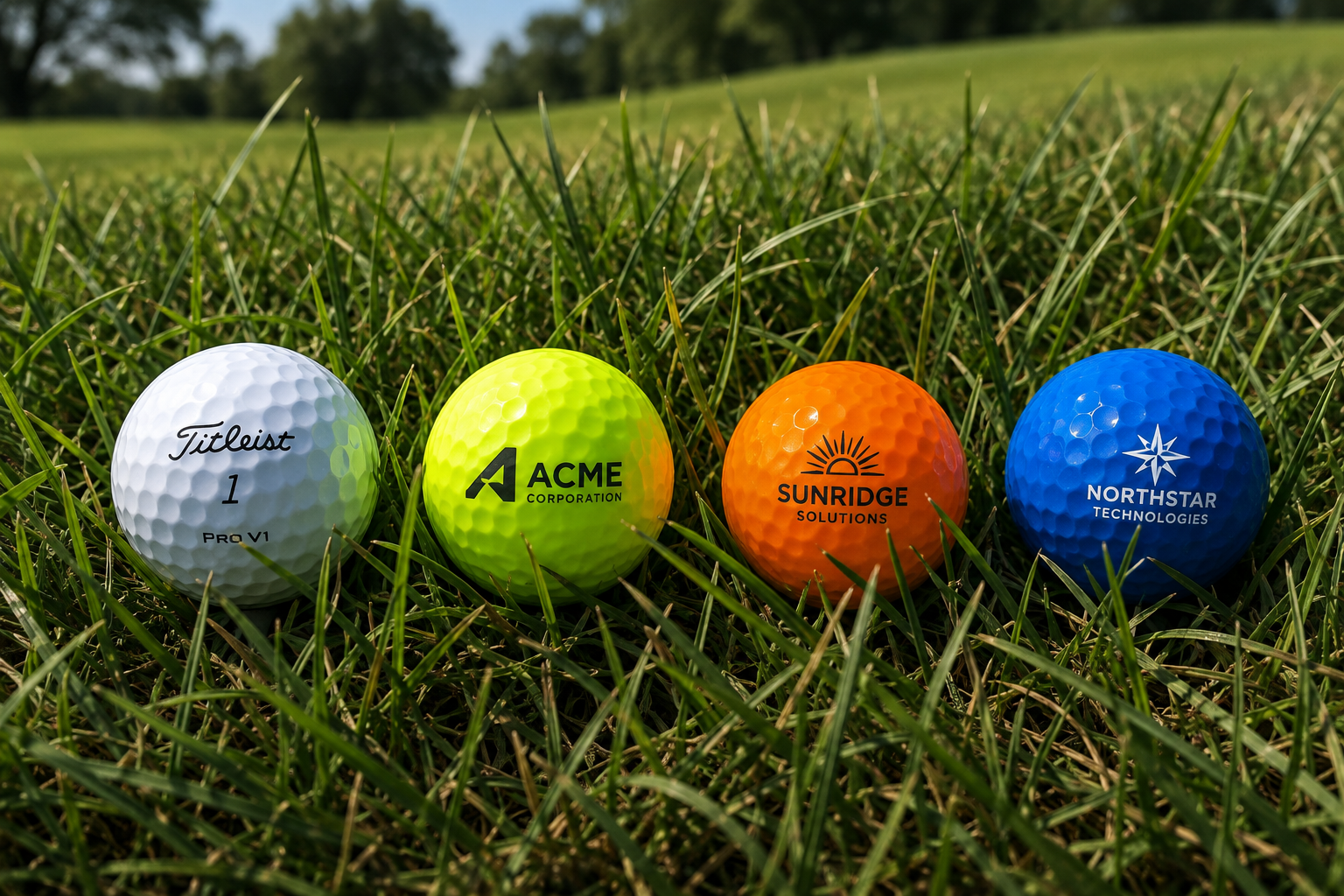
Golf balls have been white for so long that we don't really question it.
But maybe we should.
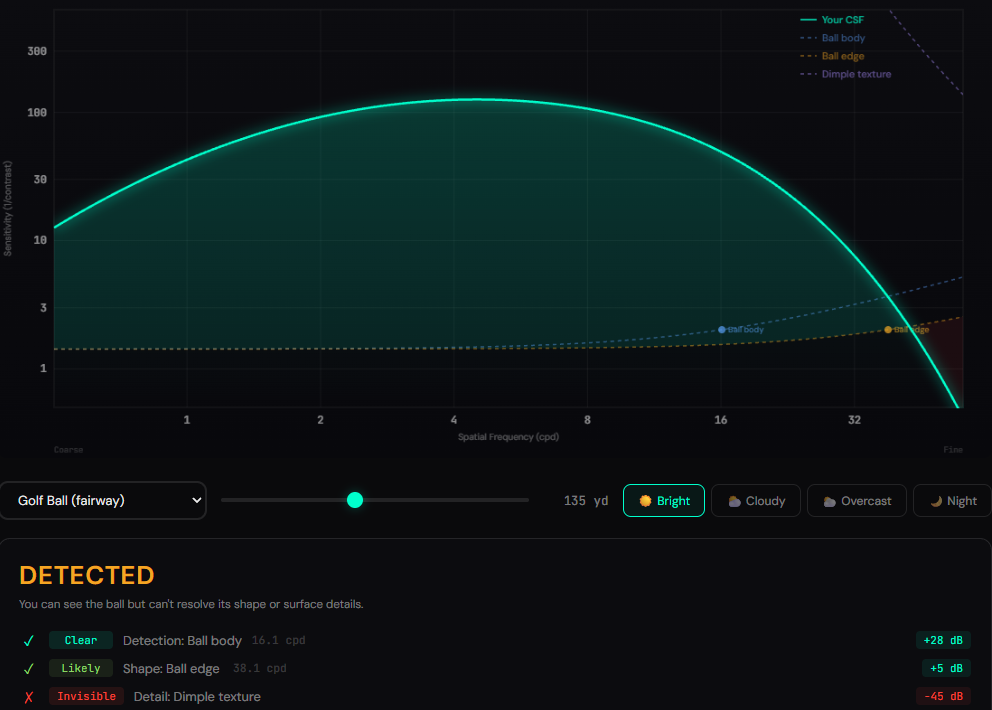
The job of a golf ball is slightly unusual from a vision standpoint. We hit a 42.7 mm object hundreds of yards away, try to visually track it while it moves rapidly across sky, trees and terrain, and then attempt to locate it after it has become completely stationary somewhere in several acres of grass.
So why white?
And if visibility were the only thing that mattered, what colour would we actually choose?
I went looking for the science.
And there is more of it than you might expect.
First, your eyes don't see all colours equally
Human vision is weird.
We tend to think of visible light as a nice democratic rainbow where red, orange, yellow, green, blue and violet all get an equal vote.
They do not.
Under normal daylight conditions, the human visual system is most sensitive to wavelengths around 555 nanometres, which sits in the yellow-green part of the spectrum.
This doesn't mean that everything should therefore be painted yellow-green. Visibility depends enormously on the background. A green object sitting in green grass may stimulate your retina beautifully while remaining spectacularly difficult to find.
What matters is contrast.
And not just one kind of contrast.
There is luminance contrast, essentially how much brighter or darker the ball is than its surroundings, and chromatic contrast, how different its colour is from the background.
Your visual system uses both.
This distinction becomes particularly important when something is moving. Research into motion perception has shown that colour information can contribute to motion processing, but luminance contrast is an especially powerful signal. Objects defined mostly by colour differences, with little difference in brightness, can be considerably harder for the visual system to track accurately.
In other words, the colour that looks most obvious when you're standing on the tee isn't necessarily the colour your visual system will have the easiest time following 200 yards away.
Golf actually creates two separate vision tests
When you hit a golf ball, your visual system has two jobs.
Job #1: Track the ball through the air.
Job #2: Find the stupid thing afterward.
These sound similar.
They aren't.
During flight, the ball is tiny, moving quickly and usually viewed against sky, trees and distant terrain.
Once it lands, motion disappears. Now you're conducting a visual search for a tiny stationary target against grass, shadows, dirt, leaves and rough.
The optimal visual characteristics for these two tasks aren't necessarily identical.
Which finally brings us to the contenders.

Vision Centre
Golf Ball Visibility Test
Which colour can your visual system find fastest?

Your visibility results
Unassisted detection rate first, search speed second.
| Colour | Unassisted | Adjusted median | Tap accuracy | Wrong taps | Hints |
|---|
By distance
| Distance | Unassisted | Adjusted median | Tap accuracy | Wrong taps |
|---|
White: the defending champion
White has been the standard golf ball colour for so long that anything else still carries a faint suggestion that you won it at a company Christmas party.
But white actually has a lot going for it.
In bright conditions, a white ball can have excellent luminance contrast against dark green turf, trees and rough.
The problem arrives when the background gets brighter.
Put a white golf ball against a pale cloudy sky and suddenly you've created camouflage.
This is an important concept in vision. Your retina isn't simply asking:
"Is there a ball?"
It's asking:
"Is there a sufficiently strong difference between this tiny object and everything immediately surrounding it?"
Against dark trees, white can be fantastic.
Against a bright overcast sky, considerably less fantastic.
So white is very good.
But it probably isn't the champion.
Yellow: now things get interesting
Specifically, fluorescent or high-visibility yellow.
Remember that peak daylight sensitivity of the human visual system?
Yellow-green is right in the neighbourhood.
But fluorescent colours have another trick.
Fluorescent materials absorb shorter-wavelength radiation and re-emit some of that energy at longer visible wavelengths. In daylight, this can make a fluorescent surface appear unusually bright and conspicuous.
This isn't just marketing.
Studies examining fluorescent targets have found that fluorescent colours, particularly fluorescent yellow-green, can be detected better in peripheral vision than comparable non-fluorescent colours.
Which sounds suspiciously useful for a golf ball.
You aren't always staring directly at the ball during its entire flight. As it becomes smaller, tracking increasingly depends on motion, contrast, attention and peripheral visual information.
A bright fluorescent target is basically yelling:
"HELLO RETINA. STILL HERE."
And someone has actually studied this with golf balls.
Yes, scientists made people search for coloured golf balls
A study involving 20 participants used images and videos of golf courses along with white, orange, blue and fluorescent golf balls while recording where participants looked using eye tracking.
The fluorescent balls won.
Participants located an average of 4.90 fluorescent balls during the search task, compared with 4.70 white, 4.52 orange and 4.12 blue balls.
More interestingly, the average time required to find all the balls was approximately:
Fluorescent: 5.18 seconds
White: 6.77 seconds
Orange: 7.61 seconds
Blue: 9.50 seconds
And in simulated ball-flight images, participants detected an average of 3.10 fluorescent balls compared with 2.25 orange, 1.90 white and only 1.50 blue.
This was a small laboratory study in young adults, so we shouldn't pretend we have just discovered the penicillin of golf.
But the direction of the results makes a great deal of sense based on what we already know about visual perception.
Fluorescent won.
Blue got absolutely destroyed.
Blue golf balls: a magnificent solution to a problem nobody had
If your primary objective is finding your golf ball, blue is an interesting choice.
Unfortunately, the human visual system doesn't seem particularly impressed with it.
Blue sits in a part of the spectrum where our photopic visual sensitivity is considerably lower than around yellow-green.
It can also perform poorly against certain natural backgrounds and, importantly, our short-wavelength visual system has relatively poor spatial resolution compared with luminance-based vision.
The golf-ball eye-tracking experiment found blue to have the worst overall visibility and the longest search times.
There is one amusing exception.
Sand.
Another study specifically looked at golf-ball visibility against different backgrounds. Fluorescent balls had the best subjective visibility on grass, while blue balls performed best against sand.
So if you spend most of your round in bunkers, blue suddenly becomes an evidence-based strategy.
Although at that point we may have identified a larger problem.
What about orange and red?
Orange should theoretically have some useful characteristics.
It provides strong chromatic contrast against green vegetation, which is one reason orange objects can look extremely conspicuous against foliage.
And in the golf-ball eye-tracking study, orange performed better than white for the simulated flying-ball images, although fluorescent remained substantially better.
But orange has an environmental Achilles heel.
Autumn.
A bright orange golf ball in July:
"There it is."
A bright orange golf ball sitting among October leaves:
"We may never see him again."
This is why asking for the single most visible colour without specifying the environment is a bit like asking which shoes are best.
For what?
The surprising importance of fluorescence
This may actually be the most important distinction.
We tend to talk about golf balls as:
White versus yellow versus orange.
But the more meaningful comparison may sometimes be:
Conventional colour versus fluorescent colour.
Fluorescent yellow-green targets have repeatedly demonstrated strong daytime conspicuity, including when viewed peripherally against green backgrounds.
That gives fluorescent yellow a useful combination.
It's bright.
It's close to the region where human daylight vision is highly sensitive.
It has substantial chromatic separation from a blue or grey sky.
And fluorescence can increase its apparent conspicuity in daylight.
This is also why fluorescent yellow-green has conquered the glamorous worlds of safety vests, emergency equipment and construction signage.
The pinnacle of fashion.
And then golfers get older
There is another factor manufacturers don't usually put on the box.
The eye changes with age.
The natural crystalline lens gradually becomes more yellow and absorbs more short-wavelength light. Measurements of human lenses show that transmission decreases with age, with a disproportionately large reduction at shorter wavelengths. In one study, the reduction between middle-aged and older groups was about 40% at 420 nm compared with 18% at 580 nm.
In plain English:
Older eyes increasingly filter blue light.
That's one more reason I wouldn't expect a blue golf ball to become easier to see as golfers age.
At the same time, aging can reduce contrast sensitivity and increase the effect of glare and optical scatter. So maximizing ball-to-background contrast becomes increasingly useful.
This may help explain why some golfers suddenly discover coloured balls after decades of insisting that golf balls are supposed to be white.
Their dignity hasn't deteriorated.
Their crystalline lenses have.
What about sunglasses?
Here's another wrinkle.
Your sunglasses can change this entire equation.
A tinted lens doesn't simply make the world darker. Depending on its spectral transmission, it can alter the relative brightness and colour contrast between the ball and its background.
Yellow filters, for example, have been shown under certain experimental conditions to increase contrast for bright targets presented against blue backgrounds by selectively reducing shorter-wavelength light.
That doesn't mean everyone should golf in yellow shooting glasses.
It means the combination matters:
ball + background + illumination + sunglass tint + your visual system.
Interestingly, an ophthalmology paper discussing sports lenses specifically noted that certain blue-green lenses could make yellow or white golf balls less visible against green grass.
So yes.
You can buy sunglasses that make your golf ball harder to see.
Golf needed another equipment variable.
So what colour should you actually play?
If my only goal were maximizing visibility across the widest range of typical golf conditions, I'd start with fluorescent yellow or yellow-green.
The visual science points in that direction, and the limited golf-specific research we have supports it.
My rough ranking would be:
Fluorescent yellow / yellow-green: Best overall candidate, particularly for tracking and general conspicuity.
White: Excellent against darker turf and trees, but can disappear surprisingly well against bright or overcast skies.
Fluorescent orange: Potentially excellent against green vegetation and useful for tracking, but increasingly questionable once the golf course starts filling with similarly coloured leaves.
Blue: Great if your golf course consists primarily of sand.
There isn't a universal winner. Sky conditions, grass, foliage, sunglasses and your own visual system all change the equation. Colour-vision deficiencies, cataract and reduced contrast sensitivity can change it further.
But if I had to choose one ball purely on visibility, the science makes a surprisingly good case for fluorescent yellow.
Golfers spend an extraordinary amount of time thinking about what a golf ball does during the fraction of a second that the club is touching it.
We might want to give a little more thought to how well we can see it for the next six seconds.
Especially since finding it is generally considered an important part of the game.
Dr. Robert Burke is an optometrist at Calgary Vision Centre. The thoughts, opinions, and analogies shared above are intended for education and entertainment purposes only (think of them like a friendly explainer, not a personal consultation.) Every set of eyes is different, and the right testing protocol depends on your specific vision needs, health history, and lifestyle. So if you're experiencing symptoms or just have questions about your vision, don’t rely on internet content alone, talk to your optometrist or health care provider directly. We’re here to help, but nothing beats an in-person exam with someone who knows your eyes.